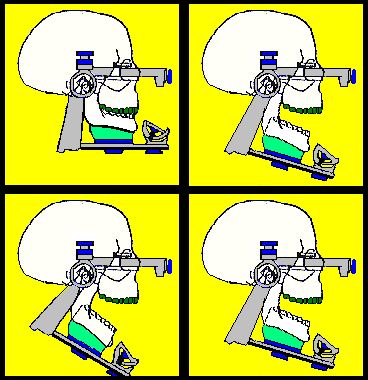
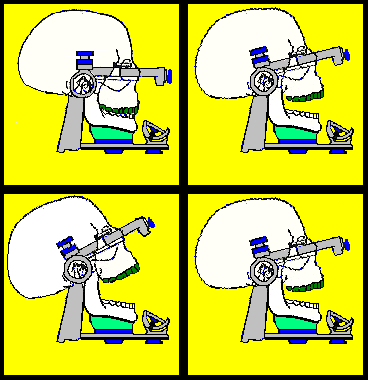
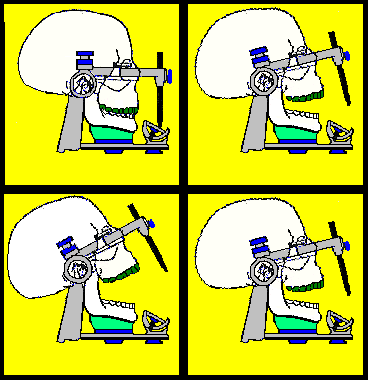
| In order
to accurately evaluate, diagnose and treat “occlusal problems”, a clear
understanding of what is intended as normal is essential. Only then
can various occlusal presentations be identified and categorized as to
what type of problem there is.
Without
elevation of the mandible, there is no occlusion (the jaw is suspended
at rest position).
The primary elevator, the temporalis,
contracts until the teeth come into contact. The temporalis’ maximum
contraction intensity occurs when there is resistance to its activity,
that is, when the teeth
are separated a few millimeters by the varying hardness of food.
The harder the food, the more intensely the temporalis can contract.
The necessity for the temporalis’ contraction is complete when the teeth
touch. In normal chewing and swallowing, the teeth are occluding
for only .2
seconds. There is no purpose for the temporalis to maintain the
teeth in occlusion for longer than .2 seconds, doing so is a parafunctional
activity.
In the normal
system, once the teeth have been occluded, the temporalis ceases its active
contraction. However, the mandible does not just automatically “spring”
back open, it must be actively re-opened, or “depressed”, which is the
job
of the lateral pterygoid muscles. During normal chewing and swallowing,
the instant the teeth are occluded, the lateral pterygoids are activated
to re-open the mandible. Since advancing the condyle down the eminence
is a relatively easy task (gravity is working with the lateral pterygoids
and there is no other resistance to their activity), the lateral pterygoid
muscles in comparison to the temporalis are considerably weaker in strength.
With this
basic acknowledgment of the normal function of the temporalis and lateral
pterygoid, their parafunction and the resultant signs and symptoms from
that parafunction become more obvious.
Traditionally,
dentists have been focused on the occluding scheme of the teeth and have
stipulated that teeth may be in occlusion for periods longer than 0.2 seconds.
Dentistry has been attempting to effect the frequency, duration or intensity
of occluding by altering the resultant occlusal scheme.
In the event
occluding does persist beyond 0.2 seconds, the nature of the occluding
scheme and the intensity of activity of the opposing muscles can allow
for various presentations of signs and symptoms. By providing for
an ideal condylar orientation and occluding scheme, dentistry can reduce
(or eliminate) dental and temporomandibular problems, although clenching
may persist allowing non-dental/non-joint symptoms to continue. An
example of this methodology (from a popular text on occlusal problems*):
“A premature occlusal contact
that displaces the mandible distally can intensify the problem of disk
derangement because it not only forces the jaw back, but also hyper activates
masticatory muscles to incoordinated contraction. Thus it loads the
condyle with extra force against the deranged disk and contributes to progressive
further damage to both the disk and its connective attachments.”
An analysis
of the above statement reveals the stipulation of parafunctional occluding:
“A premature
occlusal contact that displaces the mandible distally...” The
only way this can happen is if the temporalis continues its contraction
following the initial contact of the teeth. During normal function,
food is between the teeth, and any tooth contacting triggers simultaneous
temporalis relaxation and lateral pterygoid contraction (thereby separating
the teeth).
“…can
intensify the problem of disk derangement because it not only forces the
jaw back…” The “it” referred to here is initial tooth contact
when it is really continual temporalis contraction at work.
“…but
also hyper activates masticatory muscles to incoordinated contraction.”
The temporalis is already hyperactive (otherwise, there would be no occluding
after the first .2 seconds). The initial contact does not cause the
temporalis to maintain contraction, in fact, it was supposed to signal
the temporalis to cease its contraction. Once the contact exists,
the lateral pterygoids are supposed to contract; however, they are
met with the resistance of the occluded teeth (by way of the contracting
temporalis). This appears to the practitioner as “incoordinated contraction”
because both the elevator and depressor muscles are contacting with intensity
simultaneously (lateral pterygoid muscles have no purpose to contract
with intensity). So it is not the occlusal interference that causes
the muscle incoordination, but the persistence of the elevator contraction.
“Thus
it loads the condyle with extra force against the deranged disk and contributes
to progressive further damage to both the disk and its connective attachments.”
The occluding contact (“it”, above) does not “load” the condyle with extra
force. Force on the condyle is applied by the lateral
pterygoid’s isometric contraction in an anterior and medial direction
(the orientation of the muscle), due to the resistance of the occluded
teeth. Normally, a lateral pterygoid contraction results in the discluding
of teeth in the free advancement and sliding of the condyle down the eminence.
The so-called
neuromuscular school of occlusion utilizes a surface TENSing unit (transcutaneous
electrical nerve stimulation) to alter the presenting length of the elevator
musculature by "relaxing" these muscles to an "improved physiologic" state.
Once this had been accomplished, a full coverage "splint" (or full mouth
restoration) is provided to provide a masticatory surface compatible with
the new vertical dimension.
Resting
vertical dimension is a function of the length of the elevator musculature,
and that length is a function of the tone of the resident spindle
fibers. Spindle fibers are innervated by the tone of the sympathetic
nervous system, which can vary from day to day, or hour to hour.
Spindle fibers are naturally in a state of slight tension in response to
the pull of gravity. Surface TENSing may "relax" the spindles to
increase the resting freeway space considerably. Given that the tension
of the spindles has been indentified as the likely source of the tension
and pain of myofacial dysfunction and tension-type headache, it is not
surprising that surface TENSing can be highly therapeutic.
However,
the occlusal splint continues to provide a clenching surface. In
some patients, the condylar orientation and new artifical occlusal surface
reduces clenching parafunction, while in others, clenching simply perpetuates
or intensifies, resulting in continuing headache symptoms. There
is no predictability as to who will continue to clench with intensity,
and who won't.
Essentially,
“occlusal problems” are a result of problems of occluding, a
muscular parafunction. The
frequency, duration and intensity of the muscular parafunction, not
the scheme of the occluded teeth, or orientation of the condyles, dictates
the resultant presenting signs and symptoms.
* Dawson: Evaluation, Diagnosis,
and Treatment of Occlusal Problems, second edition, p117 |